
The amazing secrets of Kashi Vishwanath Temple: A complete and powerful guide from history to the corridor (2026)
Varanasi, considered one of the oldest continuously inhabited cities in the world, is renowned for its spiritual energy and the ghats along the Ganges River. But the heart of this city is the Kashi Vishwanath Temple. Dedicated to Lord Shiva, this temple is one of the 12 Jyotirlingas and a center of faith for millions of Hindus.
In this detailed blog, we will delve into the history of the Kashi Vishwanath Temple, the story of its reconstruction, the new Kashi Vishwanath Corridor (Dham), and the rules for visiting the temple.
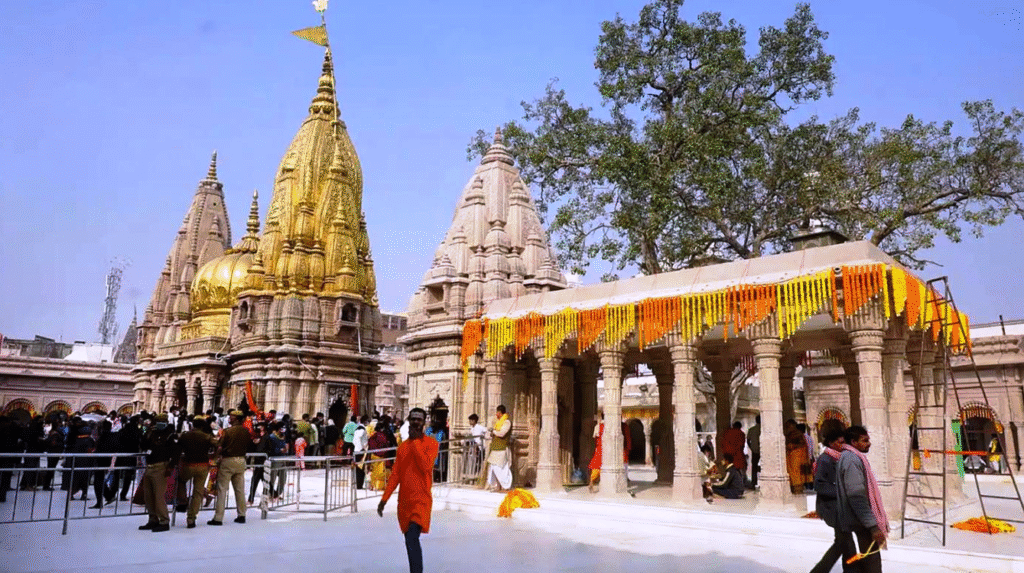
In Hinduism, Kashi (Varanasi) is known as the “City of Liberation.” According to the Skanda Purana, this city rests on Lord Shiva’s trident.
Meaning of the name Vishweshwar: The main deity of the temple is called ‘Vishwanath’ or ‘Vishweshwar,’ meaning “Lord of the Universe.”
Significance of the Jyotirlinga: It is believed that merely visiting this shrine grants liberation from the cycle of birth and death. It is the ninth of the twelve Jyotirlingas.
Union of Shiva and Shakti: The Kashi Vishwanath Temple is divided into two parts. On the right side resides Goddess Bhagwati, the embodiment of Shakti, and on the left side resides Lord Shiva.
The Temple has a glorious and challenging History.
The history of the Kashi Vishwanath Temple is a saga of destruction and resurrection. It was destroyed several times by foreign invaders, but each time, the faith of its devotees revived it.
- Ancient Period: The temple is mentioned in the Vedas and Upanishads. It is believed that Adi Shankaracharya also meditated here.
- Medieval Invasions: In 1194 AD, Qutb-ud-din Aibak destroyed it for the first time. Later, Raja Todar Mal renovated it.
- Aurangzeb’s Invasion: In 1669, the Mughal ruler Aurangzeb demolished the temple and built the ‘Gyanvapi Mosque’ in its place.
- Ahilyabai Holkar’s Contribution: The present temple was constructed in 1780 AD by Maharani Ahilyabai Holkar of Indore.
- Golden Spire: In 1839, Maharaja Ranjit Singh of Punjab donated 1000 kg of gold for the temple’s spire, which is why it is also known as the ‘Golden Temple’.
The magnificent Kashi Vishwanath Corridor
Prime Minister Narendra Modi’s dream project, the Kashi Vishwanath Dham, has transformed the temple complex. It was inaugurated on December 13, 2021.
Key features of the corridor:
Direct access to the Ganges: Devotees can now take a dip in the Ganges at Lalita Ghat and enter the temple directly. This was not possible before due to the narrow lanes.
- Area: The corridor spans approximately 500,000 square feet, while the original temple complex was only 3,000 square feet.
- Facilities: It includes a Mumukshu Bhavan (for those seeking liberation), a city museum, a library, and a passenger facilitation center.
- Preservation of ancient temples: More than 40 ancient temples were discovered and preserved during the construction.
Temple Aarti and Darshan Timings
If you are planning a trip to Varanasi, you should be aware of the temple timings to ensure a smooth visit.
| Aarti's Name | Time | Description |
|---|---|---|
|
Mangala Aarti |
3:00 AM – 4:00 AM |
The first aarti of the day (Ticket required) |
|
General Darshan |
4:00 AM – 11:00 AM |
Doors open for general devotees |
|
Bhog Aarti |
11:15 AM – 12:20 PM |
Food is offered to Baba |
|
Sapta Rishi Aarti |
7:00 PM – 8:15 PM |
A grand aarti performed by seven Brahmins |
|
Shringar Aarti |
9:00 PM – 10:15 PM |
Special adornment of the deity |
|
Shayan Aarti |
10:30 PM – 11:00 PM |
The last aarti before the temple closes |
Five (5) Amazing Secrets of Kashi Vishwanath Temple
- The influence of the golden spire: It is believed that merely seeing the temple’s golden spire fulfills the wishes of devotees.
- Gyanvapi Well: During Aurangzeb’s invasion, the temple’s chief priest hid the Jyotirlinga in a nearby well (Gyanvapi Well) to protect it.
- Avimukta Kshetra: Kashi is called Avimukta Kshetra because Lord Shiva protects it on his trident even during the time of cosmic dissolution.
- Mantra of Liberation: It is believed that if someone dies in Kashi, Lord Shiva himself whispers the Taraka Mantra into their ear.
- Architecture: The Shri Yantra and the carvings on the temple’s roof are considered very significant from the perspective of Tantric philosophy.
Important tips and guides for sightseeing
Visiting the Kashi Vishwanath Temple requires adherence to certain rules:
Dress Code: While there is no strict dress code for general darshan (viewing of the deity), wearing traditional Indian attire (such as sarees, kurtas, and pajamas) is considered appropriate. Men may be required to wear a ‘dhoti’ for offering water in the sanctum sanctorum.
Prohibited Items: Mobile phones, cameras, electronic devices, leather belts, and wallets are strictly prohibited inside the temple. You can deposit these items in the lockers provided outside the temple.
Online Booking: If you wish to attend the Mangala Aarti or perform special pujas, book your slot at least one month in advance through the Shri Kashi Vishwanath Official Website.
Avoid Crowds: Saturdays, Sundays, and Mondays are usually very crowded. For a peaceful darshan, visit early in the morning between Tuesday and Thursday.
Other attractions in Varanasi (Nearby Attractions)
After visiting Baba Vishwanath Temple, you can also visit these places:
- Kal Bhairav Temple: He is considered the guardian of Kashi (Varanasi). A pilgrimage to Kashi is considered incomplete without visiting this temple.
- Dashashwamedh Ghat: The evening Ganga Aarti (river worship ceremony) here is world-famous.
- Annapurna Temple: Located near the Vishwanath Temple, this temple is dedicated to Goddess Annapurna.
- Sarnath: Located 10 km from Varanasi, this is where Lord Buddha delivered his first sermon.
- Namo Ghat: This is a new and modern ghat in Varanasi, which is quite popular among tourists.
Conclusion
Kashi Vishwanath Temple is not just a religious site, but a symbol of India’s unwavering faith and cultural heritage. With the new corridor, reaching the temple directly from the Ganges River has become a truly divine experience for devotees. If you are seeking peace and spirituality, a visit to Kashi is a must-do at least once in your lifetime.