
Red Fort: India's pride, history and cultural heritage
The Red Fort, located in Delhi, the capital of India, is a historical landmark. It is not just a fort, but a symbol of India’s independence, pride, and cultural identity. Every year on August 15th, the Prime Minister of India hoists the national flag here. This is why the Red Fort holds a special place in the hearts of Indians.
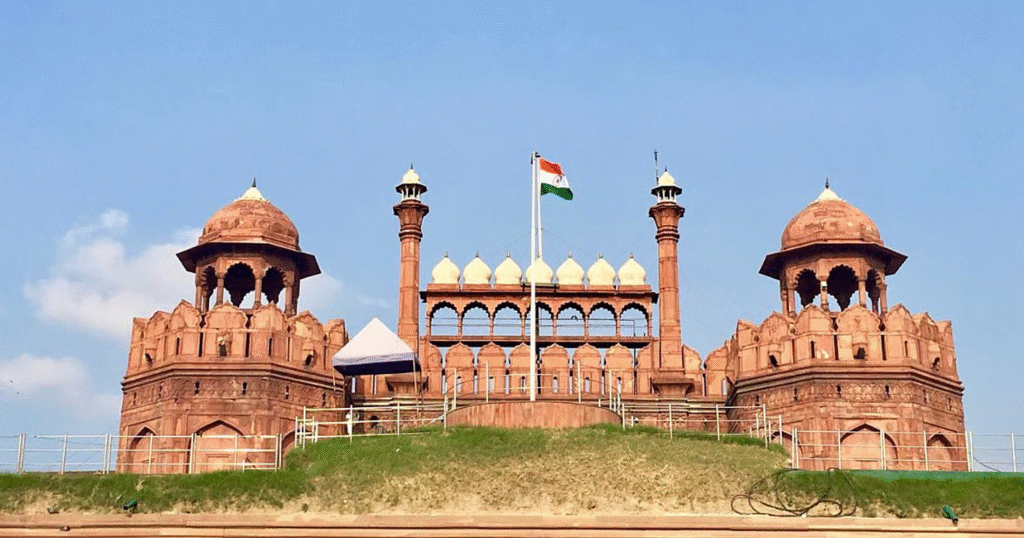
The Red Fort was built by the Mughal emperor Shah Jahan in 1638. When Shah Jahan decided to shift his capital from Agra to Delhi, he commissioned the construction of this magnificent fort. The construction of the fort took approximately 10 years and was completed in 1648.
The fort was initially called “Qila-e-Mubarak” (the Blessed Fort). It later came to be known as the Red Fort because it was built of red sandstone.
The importance of the Red Fort during the Mughal period
During the Mughal rule, the Red Fort was the center of power. The entire empire was governed from here. Important halls such as the Diwan-i-Aam and Diwan-i-Khas were built inside the fort, where the emperor met with the general public and dignitaries, respectively.
British rule and the Red Fort
After the 1857 rebellion, the British seized control of the Red Fort. They destroyed many of the fort’s structures and converted it into a military garrison. After independence, the Red Fort remained under the control of the Indian Army and is now protected by the Archaeological Survey of India (ASI).
The architecture of the Red Fort
The architecture of the Red Fort is a magnificent blend of Mughal, Persian, Turkish, and Indian styles. It covers an area of approximately 254 acres.
Main entrance
- Lahore Gate – Main entrance
- Delhi Gate – Second main gate
Diwan-e-Aam
This was the place where the emperor listened to the problems of the common people.
Diwan-i-Khas
Foreign dignitaries and special court sessions were held here. It was here that the famous line was written:
“If there is paradise on earth, it is here, it is here.”
Rang Mahal and Khas Mahal
Rang Mahal: The residence of the queens
Khas Mahal: The emperor’s private residence
These palaces were once adorned with gold and silver decorations.
Nahr-e-Behisht (Canal of Paradise)
The water system flowing inside the Red Fort is called Nahr-e-Behisht. It was designed to keep the entire fort cool.
The Red Fort and India's independence
The Red Fort is the greatest symbol of India’s independence.
On August 15, 1947, India’s first Prime Minister, Pandit Jawaharlal Nehru, hoisted the flag of independent India here. This tradition has been followed every year since then.
Information about visiting the Red Fort (Red Fort Travel Guide)
Location
Chandni Chowk, Old Delhi, India
Opening Hours
9:30 AM to 4:30 PM
Closed on Mondays
Ticket Price
Indian Citizens: ₹35
Foreign Tourists: ₹550
Children under 15 years of age: Free
Light and sound show
In the evening, a light and sound show is held at the Red Fort, which depicts the history of the fort in both Hindi and English. It’s a wonderful experience for tourists.
The best time to visit the Red Fort.
October to March
The weather is pleasant during the winter months, making it ideal for sightseeing.
Interesting facts about the Red Fort (Lal Qila)
- The Red Fort is a UNESCO World Heritage Site.
- Its walls are approximately 2.5 km long.
- The Koh-i-Noor diamond was once kept here.
- The fort has a total of 23 gates.
Why is the Red Fort special?
- A symbol of India’s independence
- An outstanding example of Mughal architecture
- A major tourist attraction in Delhi
- An icon of Indian culture and history
Conclusion
The Red Fort is not just a historical monument, but the very soul of India. It reminds us of our glorious past, our struggles, and our freedom. If you are visiting Delhi, your trip is incomplete without seeing the Red Fort.