
Varanasi: Where time stands still and the soul awakens.
If there is one place where the soul of India beats most profoundly, it is Varanasi. It is not merely a city, but an experience—an experience that weaves together life, death, liberation, and devotion into a single thread. This ancient city, situated on the banks of the Ganges and also known as Kashi, Banaras, and Avimukta Kshetra, is one of the oldest continuously inhabited cities in the world. It is believed that Lord Shiva himself resides here, and therefore, the city is said to be indestructible.
The streets of Varanasi are as narrow as its culture is deep. Every stone, every ghat, every temple, and every aarti (ritual offering of light) tells a story—a story thousands of years old, yet still vibrant today.
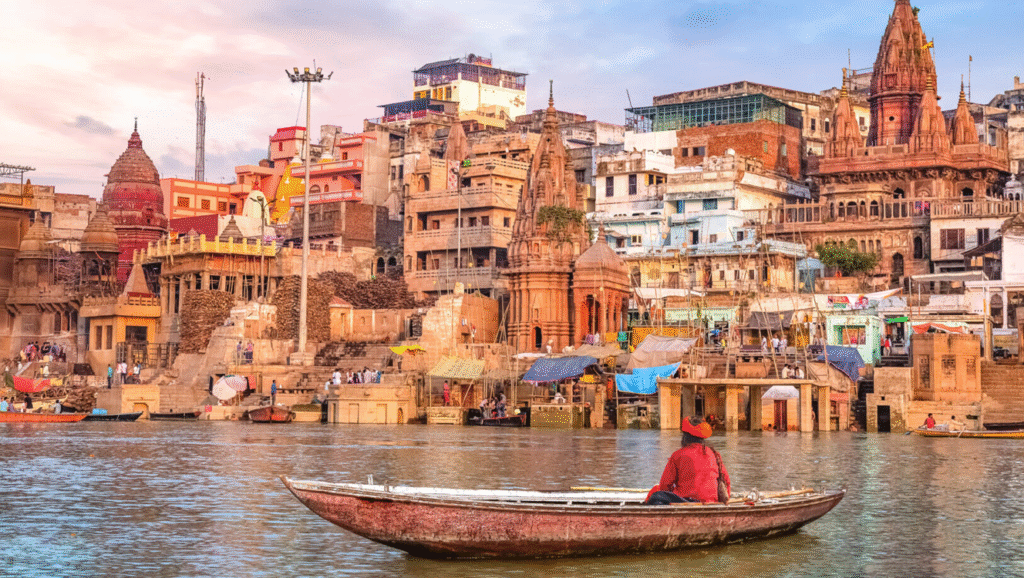
The mythological and historical significance of Varanasi
Kashi: the immortal city
According to the Puranas, Kashi was founded by Lord Shiva himself. The Skanda Purana, Kashi Khanda, and other texts describe Kashi as the place where even death becomes a gateway to liberation. It is believed that those who die here are granted salvation by Lord Shiva himself, who bestows upon them the Taraka Mantra (the mantra of liberation).
Therefore, Varanasi is known as the city of salvation.
In the depths of history
According to historians, Varanasi is at least 3000 to 5000 years old. It has witnessed the Maurya, Gupta, Pala, Mughal, and British periods, but has never lost its essence.
This city has been a major center of education, philosophy, music, Ayurveda, and Sanskrit studies. Like Taxila and Nalanda, Kashi has also been a great seat of learning.
Varanasi’s existence is incomplete without Mother Ganga. Here, the Ganges is not just a river, but a mother, a goddess, and the giver of salvation.
Main Ghat
Varanasi has approximately 84 ghats, each with its own significance:
- Dashashwamedh Ghat – the most famous, where the grand Ganga Aarti ceremony is performed daily
- Manikarnika Ghat – the main cremation ground, where the funeral pyres are said to burn continuously
- Harishchandra Ghat – a symbol of truth and righteousness
- Assi Ghat – a favorite spot for young people and tourists
- Panchganga Ghat – believed to be the confluence of five rivers
Ganga Aarti: A spiritual experience
The Ganga Aarti ceremony held at Dashashwamedh Ghat in the evening is the heart of Varanasi. When hundreds of lamps are lit, conch shells are blown, mantras are chanted, and fire is offered in worship of Mother Ganga, the atmosphere becomes truly divine. It’s not just something to witness, but an experience to feel.
One of the twelve Jyotirlingas
The Kashi Vishwanath Temple is one of the twelve Jyotirlingas of Lord Shiva. This temple is not just a religious site, but a center of Sanatana Dharma (Hindu culture).
Devotees believe that merely visiting this temple can change the course of one’s life.
Kashi Vishwanath Corridor
The Kashi Vishwanath Corridor, built in recent years, has directly connected the temple to the Ganges River. This has not only provided convenience to devotees but has also showcased the grandeur and spirituality of Kashi in a new light.
Narrow streets and the Banarasi lifestyle
The world of the streets
The lanes of Varanasi are like a labyrinth, but it is in these very lanes that the soul of Kashi resides. As you walk through them, you might encounter a cow, a sadhu, the ringing of temple bells, or people discussing philosophy at a tea stall.
Banarasi people
People from Varanasi are known for their unique characteristics:
- Sweet and gentle language
- Deep philosophical thinking
- Humor and wit
- The art of accepting life with ease
Even death feels like a celebration here, as it is not considered an end, but rather a gateway to liberation.
Banarasi sarees and handicrafts
Banarasi saree
Banarasi sarees are famous not only in India but all over the world. The gold and silver zari work, silk fabric, and traditional designs make them special.
Wearing a Banarasi saree is considered a mark of prestige at weddings, festivals, and special occasions.
Other handicrafts
- Wooden toys
- Brass and copper utensils
- Pink enamel work
- Rudraksha rosaries
All of these keep the traditional art of Kashi alive.
City of music, literature and art
Varanasi has been a stronghold of Indian classical music.
Great names in music
- Pandit Ravi Shankar
- Ustad Bismillah Khan
- Pandit Kishan Maharaj
The mornings here are filled with musical practice and the evenings with musical performances.
Literary heritage
Varanasi has been the land of great literary figures like Tulsidas, Kabir, and Bharatendu Harishchandra. Kabir’s formless devotion can still be felt in the very air of this place.
The food of Kashi: Tradition in every bite.
The food of Varanasi is simple yet unique:
- Kachori-Sabzi of Kashi
- Tomato Chaat
- Malaiyo (Nimish) – a special winter sweet
- Thandai
- Banarasi Paan – famous throughout the world
Here, paan is not just a food item, but a culture.
Festivals and celebrations
Every day feels like a festival in Varanasi, but some celebrations are particularly special:
- Dev Deepawali – when the entire ghats are illuminated with lamps
- Maha Shivaratri – the pinnacle of devotion to Lord Shiva
- Nagnathaiya Leela
- Ganga Mahotsav
On these occasions, Varanasi takes on a truly magnificent form.
The concepts of death and liberation
Varanasi is perhaps the only city in the world where death is viewed not with fear, but with serenity.
The burning pyres at Manikarnika Ghat reveal the truth of life’s transience.
People come here to understand the essence of life—that the end is inevitable, so live life with awareness.
A blend of modernity and tradition
Today’s Varanasi is a smart city, equipped with universities, tourism facilities, and modern amenities, yet its soul remains the same—ancient, serene, and profound.
Banaras Hindu University (BHU) is a great center of learning, where tradition and science coexist.
Conclusion: Kashi is not a journey, but a spiritual practice.
Varanasi is not just a place to see, but a land to experience.
Here, one connects with oneself.
This city teaches that life is temporary, but consciousness is eternal.
Those who understand Kashi understand life.
And those who feel Kashi no longer need to go anywhere else.
Kashi—where every breath is a mantra,
every ghat tells a story,
and every end is a new beginning.